https://www.youtube.com/embed/C13jVqYH520
Michael Michelini shares insights from his talk at the Shenzhen SEO Conference, where he distilled 17 years of cross-border e-commerce experience into 10 actionable lessons. From building authentic brand foundations to leveraging China’s unique digital landscape, Mike breaks down what it really takes to succeed bridging Asia and the West. This episode is packed with real-world strategies for e-commerce entrepreneurs navigating global supply chains, platform expansions, and cultural adaptations.
Topics Covered in this Episode
Build a Solid Brand Foundation
Start with your “why” before your “what”—Chinese consumers crave authenticity and a clear story that resonates with their values beyond just product features.*
Leverage China’s Restricted Internet Landscape
The Great Firewall isn’t a barrier—it’s an advantage for those who master both sides, creating opportunities through strategic content distribution across platforms like WeChat and Douyin.*
Distribution Channels Serve the Brand
Separate your content creation from distribution by building a core content database that cascades across multiple platforms while maintaining brand control.*
Stay a Student, Not a Teacher
Success in cross-border business requires humility—every customer complaint is free consulting, and teaching others actually deepens your own mastery.*
Make Video the Core of Your Content Strategy
Video is the ultimate content multiplier—one recording becomes podcasts, social clips, transcriptions, and quotations across all your marketing channels.*
Build Relationships Through Content
Long-term relationship building through authentic storytelling creates more value than transactional marketing, whether for B2B partnerships, customer loyalty, or even life partnerships.*
Add Fun and Engagement to Your Brand
Gamification through prizes, leaderboards, and interactive experiences keeps audiences engaged—Mike built a weekly prize system that randomly awards Amazon gift cards to content engagers.*
Partner Locally
Find local partners who understand the market rather than trying to own 100% yourself—test relationships through smaller projects before committing to major partnerships.*
Authentic Localization
Go beyond translation by adopting culturally meaningful names and approaches—Mike uses 迈理倪 in Chinese and ไมตรี ศรีเมือง in Thai, both carrying deeper meaning than literal translations.*
Focus on Authenticity Above All
There is no tenth lesson because authenticity encompasses everything—being real about who you are, what you offer, and how you connect is the foundation of sustainable cross-border success.People / Companies / Resources Mentioned in this Episode
- Mike’s Shenzhen SEO Conference Slides: https://mikesblogdesign.com/szseo2025
- Mike’s Weekly Blog & Prize Platform: https://now.mikesblog.com
- Cross Border Summit 2026 (Chiang Mai): https://2026.crossbordersummit.com/
Episode Length 40:19
Thank you everybody for listening in.
Download Options
- Direct Download: Right-click here and click “Save As” for a direct download
- iTunes: Listen and subscribe on iTunes for free!
- Android: Check out Android Options or Listen via Stitcher Internet Radio streaming
- If you enjoyed this episode, leave a positive review on iTunes, & more (directions here)!
Show Transcript
(00:00) Episode 476 of Global from Asia. What if 17 years of bridging Asia and the West could unlock your next big break in crossber e-commerce? From building unbreakable brands to mastering China’s digital maze, I’m sharing my top 10 lessons straight from the Shenzhen SEO stage. Lessons that’ll reshape your global game. Let’s dive in.
(00:24) Welcome to the Global from Asia podcast, where the daunting process of running an international business is broken down into straight up actionable advice. >> Welcome to episode 476 of the show. I’m your co-host, Lisa Yus, and joining me as always is the man who’s been hustling across borders longer than most of us have been in e-commerce.
(00:49) Mike, you just wrapped an amazing crossber summit 2025. I’m hearing rave reviews pouring in from all the groups, attendees, speakers, and sponsors. Spill the tea. What made this one legendary? >> Oh man, Lisa, another one for the record books. We push the bar up each and every year, and our 2025, our 7th annual, is wrapping up as the best yet.
(01:16) I’d say the speaking sessions were top tier, packed with real world tactics on AIdriven supply chains and dodging those tariff headaches. And the audience more experienced and insightful than ever. Folks sharing war stories from scaling 8 figureure ops in SEA and cracking the Alibaba code. Pure gold. >> Yes.
(01:38) Let’s plug in some testimonials we already received at the event. These are short clips from attendees. Raw and real. count my minutes to come here like every year. Uh it’s a wonderful place to make connections, to make meaningful collections and to learn. >> So I think as the first time joiner, I found that this event is really insightful and I can learn a lot about e-commerce.
(02:03) >> And we are here at the cross border summit in Shiang Mai, Thailand. It’s been a great experience thus far. More than what we expected. Met some great people, some great names in the industry. meeting people, meeting other sellers. It’s a very good and open atmosphere here. People are exchanging ideas.
(02:22) So, if you want to create your network and and get ahead, then this is a great place to come. >> Truly powerful stuff. Getting people fired up and ready for 2026. >> Absolutely, Lisa. We’re already kneedeep in planning Crossber Summit 2026, upgrading the venue right here in Chiang Mai. Early responses are electric. Tons of repeat attendees locking in spots.
(02:45) Cannot wait to level up again. >> All righty, let’s get into today’s show. This is a special recording from months back when you spoke at the Shenzhen SEO conference in China. You dropped lessons learned on doing crossber business between China, Asia, and the Western world. Timeless wisdom from your 17 years in the trenches.
(03:08) Let’s tune in and break it down. All right. It’s late on a Saturday, day one. Who’s going to Morton’s tonight? The afterparty. Afterparty. Yeah. I a lot of hands. A few hands. I’ll see you there. That’s a picture. It’s a little blurry, but that’s me in September 2007 in Beijing. It was a little bit cold and there was a lot of dry.
(03:33) Like I remember I had to keep water next to my bed at the hotel to stay dry. So, we’re going to talk. It’s gonna be storytelling and learning at the same time. That’s how I like to do it. And I want questions at the end. So, I hope I don’t talk too much, but I got about 10 different things I want to share, strategies, and lessons that I think is not really e-commerce, more about marketing, branding across borders.
(03:55) And I hope you get something to take away. So, if you want to scan, you don’t need to, but that’s a prize website I built, and I’ll be sharing about it later. I also have some one of my books I brought in my bag and I’ll give a few of those away at the end of the session if you want to try to participate.
(04:12) It’s hopefully it loads in Chinese internet but I vibe coded this last month. It’s a prize website. I’ll share how I did that later. Okay. Who am I? Michael Molini or my is my Chinese name which is a change of my family name. And that’s me in 2017. Do I look the same or different? Let’s see. No, this way. Yeah, that was that. Can you believe that was 8 years ago? But that was 8 years ago picture.
(04:43) My wife made me do some professional photo head shots. But I’m a American still. Trying to become a not American, but I’m still American. And I am known as a e-commerce expert and a crossber e-commerce expert. started selling on eBay 2004 while I worked on Wall Street in New York City. I came to China 2007 and I haven’t really left.
(05:06) I’m in Mai now. I have a Chinese wife and I have four brands, seven figures and I do a conferences. We have summit in a couple months with with top sellers around the world and global information is my podcast and I’ve been doing this for a long time. I’ve been at SEO conferences in 2009 in Shaman, China at Time V.
(05:26) I’ll show you some pictures, but that’s Alan Chu. Net Concepts. Anybody know Net Concepts or Allan Chu? It’s crazy. The whole industry has changed. Been on TV and other I love engaging with people. And I don’t think this is going to load, but it was one of my first YouTube videos. I did YouTube videos in 2007 when I came to China.
(05:46) And this is at a KTV where I did a business deal, but I don’t think it’s loaded. But this is some pictures of me. 2009. It’s still online in Cena, but I was in Shaman sharing about keyword research and SEO to Chinese internet marketers in around my birthday, April 2009. Came back again in 2010 and I did that for many years.
(06:12) I met a lot of people ran fishkin from SEO m and all. But the whole industry is different now. It’s really crazy. The whole SEO industry is totally different. And yeah, like I went to lots of different conferences. I did startup weekends in China, in Hong Kong, all over China. Met people from everywhere. And this is a thing I made and maybe it’ll inspire you.
(06:36) My sister thinks it’s disgusting and sick and she yells at me about it. But this is like a lifetime life counter. So this how long I’ve been alive. I’ve been alive for 44 years, 5 months. It’s a little bit This is a screenshot from last week. So I’m a week older and I have about 35 years and 6 months left to live. if I live to 80. So, you can make your own at alive4.com.
(06:57) It’s one of my domains for free and you can save your own URL and be like me and look at this every single day. Maybe it’ll motivate you to do things outside of your comfort zone. Like they said in the intro, you push your limits. Another session somebody said, I think Mad said, you don’t grow unless you’re under pressure.
(07:18) I spoke at the Nomad Summit in January and I don’t like to say the politically correct stuff. I said, “You have to burn out. You have to push your limits.” And they’re talking about, the other people on the panel were talking about, “Don’t burn out. Don’t work too hard.” I said, “No, you work hard, you push your limit, you break your limit, and then you get stronger.
(07:34) ” Just like at the gym, if you just do the same bench press, you’re not going to get stronger. You have to push until you can’t push anymore. And that’s how you grow. So, number one, building a solid brand foundation. I like to build my personal brand. I love personal branding. I’m guess I’m doing this for my personal brand.
(07:56) The companies I own don’t pay me for this. I I guess this is out of my own pocket to come here today to build my personal brand. But basically, you have to build a brand. Whether it’s a service brand for your agency, a product brand for your e-commerce brand, a personal brand for yourself, all or all of them.
(08:14) I love building brands, right? They I was introduced as e-commerce. E-commerce is one thing, right? You’re building brands that people trust and people give money to. So you we’re going to talk about some of these in the next slides, but essentially your story, who are you? And I hope I’m clear of who I am.
(08:35) I know I guess I’m mix between e-commerce, SEO, crossborder, American and China or Asia, but you just want to be as clear as possible and no confusion whether it’s your product, your personality, your service, especially between borders, especially between translations, especially with AI. Now, you want to be super clear because actually I feel like AI is just another Chinese person.
(08:59) No offense to Chinese people, but it’s just about different culture and understanding. You have to be super clear. And I learned this when I work with Filipinos and VAS. I work with Chinese factories and I work with AI robots now. I talk to AI all day now, right? A lot of us are vibe coding. A lot of us are doing different things with AI like Chad GBT even prompts to be effective.
(09:22) And people say, “Oh, I don’t get anything out of this. I don’t get anything out of this.” Cuz you’re not clear. You got to be super clear with what you want. Anyway, super clear about who you are. So, a really powerful video I recommend you watching for free on YouTube is Start with Why by Simon Synynic. I believe he has a book too, but the video is good enough.
(09:41) It’s a TEDex video from 15 years ago and it’s really powerful for your foundation, your brand. JP or John said at the beginning of this morning, Chinese are not good at branding. I think the reason Chinese are not good at branding is they start here. I sell USB. I sell I sell this product. Buy my product. Here’s my name card.
(10:06) Add my weight wheat wayen. I don’t even know who this person is. He’s uh I said on the panel this morning, he’s a rice cooker, but his photo is a rice cooker and he wants me to add a We chat. Add my WeChat. This is the what, right? What I sell, what I do. But you got to go to the why. All right. Right.
(10:23) So, everybody always talks about Steve Jobs and Apple and they talk about in the video also it talks about the why. It’s to change the world, right? To not be the status quo. To not do what everyone else’s do, to not do what Microsoft does, to not do what the PC does, to make an Apple computer, to make beautiful products, right? To make things that change the way you work work, change the way you are, right? He doesn’t sell computers or phones. He sells creativity and change.
(10:53) Right? To not be the same, to be different, to think different. That’s what Apple sells. That’s what their brand is. Their brand is not Apple iPhone. Their brand is status, creative, unique. That is what they are, right? That is the why. The what is just the result. The re the what is just what they sell.
(11:16) But Chinese people always start with I sell this. Buy my product. Buy my service. And that’s why they’re having trouble with branding. That’s why Chinese people here have trouble with branding. They just focus on the what their boss hires you to market you so you market their product. You got to start at the why.
(11:33) Lesson number two, I leverage I leverage it, right? I was here before the great firewall became a thing. I was here when I could go on YouTube and Facebook in 2008. I was here and I think it got blocked in summer of 2009. And I remember this almost August. I almost remember this exact day. And I I don’t know if I’ll get political.
(11:54) I remember the exact reason, but I I complained about it for a long time. I complained about the firewall. I complained about internet not working. Then I realized this is an advantage. This is an advantage I have. I’m able to use both sides. People on the outside can’t get on the inside. People on the inside can’t get the outside.
(12:15) Right? So, it started to get me to really get deep on using data and distribution to be able to get my content into across borders. It got me into blockchain. It got me into Bitcoin. It got me into everything. The the great firewall I’ve changed my life. So, thank you great firewall. You gave me opportunity. You gave me not you made me stronger.
(12:39) So, we’ll talk about this in the next slides. I make lots of language websites. I have my personal website. I have blog websites. I have WeChat accounts. So the way I do it is I I had to adjust since the great firewall and I suggest a lot of you do it is I make a distribution like almost like a database and now that I’m vi coding I make it even more technical but you could just start with a spreadsheet and you have your English or your core version and then your video.
(13:10) I use file servers that are not blocked in China so that people in China can access my content and then distribute it onto different Chinese social media platforms like WeChat and other platforms. But basically, you’re building distribution. So I separate the content creation from the distribution where a lot of people just build for a certain channel or they build for a certain platform.
(13:31) I build a core content library usually in a Google sheet and then I have my different content in a Google doc and then I have my file server for the videos to download so that my wife helps me a lot Wendy you’ll I’ll talk about her later too. So they can get this content and distribute it across different channels and they can put it on to WeChat.
(13:53) It’s not a big deal right it’s just another content they’re dist distributing. So like to show a little bit more visually, you have your content hub here and then your platforms and then your branding control. So I’ve broken these down into different ways of doing my content marketing. And I think the GFW actually helped me to become stronger at this because I had to learn to not just make content in say a WordPress blog back in 2008 and then publish it and then market it.
(14:28) I had to make it earlier than that, right? And then it was going in from like a Google doc or a different file into a WordPress blog or into a WeChat account or into a Facebook post or into a different distribution. Some of my content I think can ch mentions I’m every I’m everywhere because I just put it on one core database and then I just distribute it.
(14:48) So I think I’m leveling up. Anybody follow my content knows I’m diving deep on AI coding and I’m using it for content distribution. So I’m building APIs and I’ve been talking to a few of you the last couple of days and what I started to see is websites are just databases of content. They’re just databases of content and their distribution together.
(15:12) So, I’m starting to separate my e-commerce products from my website and I’m building a basically a distribution channel for my product database and my content database separate from my distribution channel. So, I’m a I’m mostly a seller at Amazon. I have traffic on my websites. But what I’m starting to really do is separate the data layer from the distribution layer even more than I have been doing ever before through APIs.
(15:39) So lesson number four, I mentioned this also in the panel. I thought I was a teacher. I thought I would come to China and teach Chinese people to do marketing, to do business. I came in September 2007 and I remember how chaotic it was and out of control it was. And I was like, I can teach Chinese people to do better, to be more efficient, to do things the right way, the US way.
(16:11) As I’m saying, as you can tell, I’m changed my mindset. But you have to be a student more than a teacher. I have to learn from other people, especially if you’re doing crossber business, international business. That’s why Americans have a bad name. Donald Trump just made $100,000 on H-1B visas like 10 hours ago, right? Like he’s putting up walls.
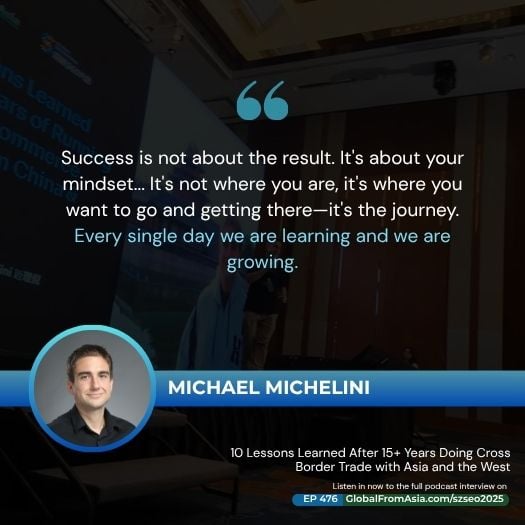
(16:33) America thinks that we’re like the center of the world and everybody needs to like revolve around us. And I had this mindset to be honest when I first came here and I learned that there’s a lot I can learn from other cultures and other people and it’s really about your mindset. And so once I changed my mindset, I think a lot of times success is not about the result, it’s about your mindset.
(17:02) And my my my blog slogan is it’s not where you are, it’s where you want to go and getting there. It’s the journey every single day. We are learning and we are growing. So I always am learning, but I’m teaching as well. I’m here sharing with you. I hope I get some good questions from you later. He asked, Andy asked if I wanted questions.
(17:25) I hope I have enough time for questions. I want to learn from you. I want to grow with you. But sharing, of course, to be honest, I learned the most when I’m forced to make a presentation, when I’m forced to make what I know clear and comprehendable by other people. Throughout my career, I’ve been sharing and teaching my team, people here that are here listening.
(17:48) So by teaching you’re learning as well. By teaching you are getting a perspective and you have to compact your knowledge and be able to communicate it to other people enough that you have to actually be even more of a master of this content and knowledge. So I constantly also am trying to teach with the student mindset.
(18:08) Lesson five I think is obvious but everything revolves around video. I’m recording this right there. I got a like informal tripod on my backpack recording. This will be a podcast on my show probably in a couple weeks. It’ll be transcribed into text. It’ll be made into posters. It’ll be made into a quotation. I’ll have Alvin and my team make this into two minute one minute videos.
(18:31) Two or three one minute clips of this video right now. Alvin, maybe this right here. I was also inspired by Gary Vee. I met him in Hong Kong back in 2017. I remember what he said to me cuz I had my big old camera and I was meeting him waiting to sign getting his book signed and I I was recording it while he’s signing my book and I’m asking him a question and he’s you just keep hustling like you are right now and I got that on video but video is the core right or although I wonder when it’s going to be in our neuronet like when Elon Musk’s neuronet comes maybe
(19:02) it’s going to be like what your specific thought is but for now I think it’s a video is the core content you should be making. I honestly am not comfortable speaking up from front of you right now. Honestly, I’d rather do text. I’d rather do text, but I believe video is what you should be doing first.
(19:25) Speaking here, making a video. It’ll be this will be audio podcast. This will be a text transcription. It’s going to be tons and tons of content for what I’m doing right now. So, I’m trying to always leverage what I’m doing. What’s the highest leverage thing you can do? I also recorded a panel, although it cut my head off cuz I put this thing down here this morning and it cut my head, but I might still use it for a audio version.
(19:48) It might be a audio version. You get the idea here, right? I’m speaking of verbally, but from the video, you get the audio. So, actually, a lot of my podcast listeners of Global from Asia don’t watch the videos. They listen to the audio. So when I record the video, I keep in mind that they’re not maybe watching because a lot of them I talk to, they’re not watching it.
(20:09) They’re listening to it while they’re traveling. So a lot of people still listen to audio podcasts in my opinion and from the people I talk to, a lot of my subscribers are still audio only. So I still always record my videos thinking that they are not watching. And actually, I think a lot of people on YouTube also are just listening, not watching the YouTube videos.
(20:30) But of mine’s on iTunes. So then we have the podcast, right? And this is Sean Chow. He actually never does podcasts. He’s a huge seller. I think maybe eight figures, but definitely high seven figures. Multiple brands based in Chiang Mai like me. And I can see this is the spreadsheet. A little blurry with the script. Of course, AI helps all of us.
(20:56) We shouldn’t hide from it. This is AI generated. So what I do is I set up a Grock. I like Grock personally. I set up a Grock project. I train the Grock about my show format, my show audience, my all the different inputs about my avatars of my listeners and then I dump my show notes into it and it outputs a nice outline here.
(21:19) So I get a nice show notes, right? We make quotations. The biggest downfalls have become the biggest opportunities and growth levers for us. It’s just how you do it. Shancha, right? We have audio clips. So, this becomes this massive distribution that you can use. And I love I actually love it. I don’t know if Henry made it to this session.
(21:39) Henry’s here. Henry’s in Hong Kong and he came to this and he bumped into me randomly at this conference and he I met him in Hong Kong in 2019 and he remembered me here and he remembered me and we chatted and then I remember meeting him and he follows some of my shows and he follows some of my content. You’re building relationships, right? This is not just about marketing.
(22:04) It’s not just about getting customers. I believe in long term. I invest for long term. I’m going to be doing what I’m doing now for another 10 or 20 years. I can’t even believe the SEO industry. There’s nobody even I think there was there’s nobody here that was at the SEO conferences in China like 10 years ago. It’s really crazy.
(22:24) So, I’m in this for the long term. I’m building long-term relationships. I’m referencing content. You can see like when I make content, I think about it in 5 years from now and I’m indexing into AI now. So, you’re building relationships and I even think you’re building relationships AI and I might have my AI girl second wife soon. Don’t tell Wendy. There’s Wendy.
(22:45) But I met my wife on Waybo. I met wife on Cena Waybo in 2012 in Beijing. I was doing a startup. I was in a accelerator program and I was sharing my stories on on social media and I connected with her. I even remember this exact post I I showed the exact post that connected with my wife.
(23:10) I don’t know if I want to take my shoes off right now, but I had I was shopping for shoes in a store in I was in Dalian and there was a fake shoe market and I said, “Should I buy the fake Adidas or the fake Nike?” Vote below. and I think the Adidas won and I bought the Adidas and my wife liked that post and we started to talk in DM and she was in Beijing and then yeah that’s the wedding photo at the So if you go to a Chinese woman’s hometown this what I hear is you’re going to get married.
(23:50) Is that true? If they invite you to the hometown you’re going to get married. >> It’s true right? I found out a few of my other friends say, “Yeah, if your girlfriend invites you to go to her hometown, it means you’re going to get married.” So, anybody that’s listening now, if you don’t know that foreign guys, if you go to her hometown, it’s a high chance you’re going to get married or pushed into.
(24:15) I think it’s true. It’s true. >> Yes. Okay. I didn’t know. I found out, but there’s those rental. You can rent a boyfriend or girlfriend to take the hometown. There’s a service now like you can rent no >> sometime somewhere having this like this because of such a reason. >> Yeah, there’s pressure from the family.
(24:36) So you can rent a boyfriend or girlfriend to take to your hometown. But I was not a rental. >> I was a real agenda jada. I was genda. And try to have fun, right? I don’t know. Some people don’t like what I say. Some people think I’m politically incorrect. I’m offensive. I I try to I hope I didn’t offend.
(24:56) I see some people leaving. I hope I didn’t say something offensive about something, but I try to keep it real when I say stuff like, so I’m especially with AI now, there’s less and less excuses to add engagement into your content. So, what I do now is I’m trying to gify everything. I’m trying to update all of my tools and my softwares and my content.
(25:18) And I’ll show you in the next slide, but I think everybody likes to win games. Everybody likes Everybody likes Actually, to be honest, if I had another week or something for this presentation, I might have been able to have something more. I have a half done coded like event engagement software I made.
(25:33) I didn’t want to risk it today to show it, but I’m really working on engagement software, engaging things, right? And this is what’s supposed to be done with AI and and you can get people points. So, I sell on Amazon and I put insert cards in my packages and I have scratch off cards and I highly recommend to do that.
(25:50) I know some Amazon sellers are scared they’re going to get banned by Jeff Bezos. I still put inserts in my packages. I don’t beg for fivestar reviews. That is a little bit dangerous, but I I do try to collect emails. I try to give prizes and I’m going to start to add even more engagement with AI now. So, I’ve been testing it and some of you that scan my QR code might see what I had made, but I’ll show you a little bit here.
(26:18) So, I have a weekly blog where I share what I’m up to every week. And I’ve been doing that for about 10 years. I learned that from Tim Connley, who is a business coach, successful business coach. And he says you should share every week like with your team what you’re doing. And I used to share just to my team, but I was like, why not just share with everybody? So, some of you maybe follow me, you see me, I do like a weekly update.
(26:41) I recommend everybody to do it. But then I was like why not add engagement to it. So now I made this I coded this with replet but now domikeblog.com separate than my content site but this is a pure prize website. So, every week when I share content of my weekly blog, I have a random winners. And I’m still testing this, but what I do is every Friday at noon Thailand time or 1:00 p.m.
(27:14) Thai China time, I randomly pick certain amount of winners to win $25 Amazon gift cards for engaging with the content in this platform. And I’m trying to I know some people don’t trust and think I don’t really give the money or this person’s not doing it. So I’m really trying to make it transparent as possible. You can see here SC carryon one on September 6th and DA 29 one and there’s testimonials and Don one. Although Don doesn’t want it.
(27:40) He says he just engaged with my content as my friend. He doesn’t want the $25. He messaged me yesterday. I don’t want the $25 gift card. So if anybody wants Don’s gift card, I said, “Dude, I don’t know. I don’t want it back. It’s in my system. It’s assigned to you. You got the code.
(27:55) You can go to Amazon redeem and redeem $25. I already I don’t know. It’s part of my system. I maybe I can have something where they opt out of winning $25, but I budgeted at this. And I recommend you do this for your websites, your businesses. A lot of actually Chinese sellers do better at this sometimes than foreign sellers on Amazon.
(28:14) They do a lot of rebates, giveaways, coupons, and I think now with AI, we can make these ourselves rather than just coupon platforms or giveaway platforms. These is I don’t think it’s that difficult. And maybe you have somebody in your team that’s a little bit technical can make these platforms, but I like to I’m really going to work hard to make these leaderboards and engagements on every kind of brand I have on my Amazon brands.
(28:39) I haven’t gotten implemented because it takes such a long time to get the card system and and you can’t change it once you get it into the packaging. So, I’m testing it now on my personal blog, but I really believe having engagement with the people is something AI can do. Everybody wants everybody thinks AI vibe coding is going to make the next million billion dollar company and I hope somebody here would be can make that.
(29:03) I’m not trying to make software for making a billion users. I’m trying to just inc improve the people already subscribed or engaged with me to connect with them better. Whether it’s even my team, I’m making a lot of tools for my team, but I’m making tools for my audience or my my my people that are already working with me and I can’t wait to improve this funnel and I recommend anybody here with any kind of a brand to do this.
(29:31) You can get a system in place and it’s almost evergreen. So, I I just budget a $50 a week, $200 a month, automatically giving $25 gift cards to two people every Friday. And my team is managing it. So, Sally on my team, she’s all excited. She feels like she gets to click the random button winner on the software and it picks two random people and then she gets to email them.
(29:53) They won $25. I did four prizes. I’m testing how many I could, but I’d recommend you make these tools and engagement. Another lesson is partner locally. I shared a little bit about this in the panel, but I used to want to do everything myself. I my original strategy and actually I think this is a strategy a lot of foreigners do.
(30:15) I’ve worked with huge aggregators and during COVID buying Chinese Amazon companies here when I was in Shenzhen, they want to own everything. No, no partner, no no partner, just want to own 100% foreign 100% themselves. But I I I now look for local partners or at least industry experts to be a partner in that business. It says Starbucks.
(30:40) Actually, this is AI helped me a little bit with this. I use this gamma.app. I exported as PowerPoint for this presentation, but this is gamma. So, I made this with AI. But basically, you find local partners and work with them closely. So, picture easy China warehouse is one of my businesses. I bought this about a year and a half ago, this company.
(31:03) Brian’s the original owner, Brian Miller. I’m American and he was leaving China and he was looking for a buyer and we made a deal and I bought the business from him and it’s a company that help people do FBA shipments and DTOC shipments from China in Shenzhen in Bawan. I was just there before this conference.
(31:22) And then you can of course ask me, that’s Rosie and Shiaoang. She’s having another baby now. I asked her, “How many more babies?” She’s had another baby. Great. And then Justin’s my partner. So he and I joined as partners in this business. And he’s the CEO. I am a investor. I’m not the Laan D. Laan. He’s the Laan. He’s Laan, not me.
(31:47) I could have been Laan when I had this opportunity. Brian came to me. I could have bought this whole thing myself. I could have done this all myself. I could have maybe owned all of it. But let me go back stay in that picture a little bit longer. So he’s done a great job. He’s working super hard. I think he’s even working right now. Justin’s great.
(32:06) I’m really amazed to how he’s from Guangjo. He’s It’s amazing. But I of course he’s not like totally random to me. I got to know him from Don who got the $25 gift card. And Don I met from events, right? It’s like this long when you start to do business a long time and you’re doing this for the long term, you’ll meet people in your travels and you don’t know what’s going to exactly happen.
(32:28) But Don connected me to Justin and I work with Justin on some sourcing projects and everything is a test. Life is a test. He did good. We did a couple more things together and then he became my business partner and he Mike, how did you trust me enough to bring me into this deal? And I guess like Mad said in the session, you get a gut feeling, but you also work with people and test people.
(32:53) There’s a lot of people that fail my test, they fail my test. I try to work with a lot of people. I try to give people opportunities or try to give people projects, but if it doesn’t work, you got to cut it right away for whatever. Maybe it’s my fault or other fault. Sometimes it doesn’t work with certain people. So, it’s not like I’m just saying partner with anybody, not just any Chinese person.
(33:09) I’m a foreigner. I trust partner with anybody. You work with somebody, you test your relationship, you you make sure he’s like a wife to me, right? He’s my business partner. And there are some difficult discussions. I’m not going to say it’s perfect. There’s some discussions about money, discussions about strategy.
(33:26) We’re not always aligned, but you need good partners and you need good local partners if especially in China or other markets that you can trust and authentic. The tie is a little bit mixed and messed up. I should have had on the opening slide. Some of you see my Chinese name on some of this present in but my name my Chinese name is my probably say it wrong my me it’s a little translation that my college friend gave me Gausing he’s a Chinese American educated returning high quay super rich guy now way more rich than me gave me that name
(34:05) when I first came to China he also introduced me to Yang Ro Palmo he’s like there’s this restaurant I think you’re going to like like what? And then he got the yongro palmo and he that’s still my favorite dish. I love yang ro palmo xian food. Yeah. And rojam mo. Yeah. We have rojamo and yangro palmo.
(34:28) It was really good. And he gave me my Chinese name that night at the restaurant in 2007 or eight. And I have my.com pinion if you want to look in all Chinese. And I’ve been in Thailand now for 5 years. So my tree which is really wrong and it’s seems like it’s even not shown correctly here but my tree sounds like my name but it’s also means goodwill in Thai.
(34:56) So there’s strategy, right? I have a Thai assistant to help me. So I have meaning, right? It’s not just like a literal translation. It’s meaning. So we’re at 10 minutes and I do want questions and it’s mostly on time. There is no 10. There’s nine. And the point is you got to be flexible. The point is things don’t go to plan.
(35:17) Even this morning the panel I might have had to host the panel. There was maybe somebody couldn’t make it and they were asking me if I could host a panel. I you got to be flexible, right? Nine is 10. Chabad. I’ve learned chabad and I’ve learned to live with chabad. So, you got to be flexible. You got to be authentic.
(35:35) You got to keep it real. I don’t like speaking in public and I do it. I don’t like organizing events and I organize a conference every year. I don’t like it and I do it right. So, you got to keep it real and deliver value. I really hope I help inspire you something. And the winners are honestly Maybe we’ll do it in questions and it’s under my camera.
(35:56) But I have a few my one of my books, Empower the Seller. But maybe we’ll do questions first and then I’ll do winners. But then some stuff. Mike’s blog. This is my WeChat official account, not my personal account. If you want to scan that, give a second for that. Also, if you have questions, I don’t know if we check WOVA or if people just want to ask it like normal people do. Yeah, take questions.
(36:22) >> Take questions. Normal. Okay, we got >> questions. >> We got I hope there’s questions. I left time. >> Your block. >> Oh, sorry. Thanks, Andy. >> And then same QR code for the Global from Asia. It’s the same QR but my podcast. Yes. >> Okay. I think Yeah, it’s mic’s not working. But you said how I made the China content work or just the content strategy again.
(36:48) I’ve been doing it for 15 years and it’s really crazy. I started selling online in 2004 and I still am selling online. So I’ve been doing that 21 years, but I’ve been doing crossber e-commerce and trade and 15 years. So it’s not like it’s been the exact same process those 15 years, but like I met my wife on a way and I actually don’t know if she knows but I use a lead generation tool to find her.
(37:10) So, I forgot the name of the tool, but I did bulk mess DMs to people in Beijing that did BD in a app store, and I hit the daily limit every single day for five, six, seven days, spamming every single BD person in Beijing. And I used my white face. I specifically had my profile photo on Cena way in English and I still DM Chinese only language profiles like Wendy with my English only DM from my English face saying I’m coming to Beijing from Dalian and my basically I made a lot of relationships like that and actually I think because Cena way
(37:51) was the only platform and I was even trying to get other foreigners like I used to speak about Cena way in 2011 and 12 saying foreigners should come on waybo to do business in China. So, I made so many business contacts from Waybo. Just one example, I just made $30,000 a couple months ago from a broker deal.
(38:10) So, sometimes I’ll help Chinese people buy American brands, Amazon. I got another lead. So, I get like B2B leads or like wives from my content or I have like low. You’ll see my views are not huge, but that I believe the value of my contacts are it’s it’s like B2B. It’s not B TOC. So, you’re building strong relationships with people to build like partnerships, broker deals, marriages, things like that.
(38:41) It’s harder for me to measure, but I believe it’s like in a B2B space and a smaller space where I get high value transactions from it. >> I hope that helps. >> Thank you. Do we have other questions? Sorry, I could get the book. He gets a book. >> Boy, Mike, you shared some amazing insights there. Not just on the business grind, but the personal side.
(39:03) Mindset, culture, flipping perspectives. It’s a reminder that crossber isn’t just deals, it’s people. >> Spot on, Lisa. What I’ve learned and what I recommend to everyone is ditching the pure business lens. It’s about us, our biases, our views. Step into the other side’s shoes. Supplier in Shenzhen, buyer in Seattle, and magic happens.
(39:28) Relationships over transactions every time. Preach. Also, I know you’re currently on a yacht in Phuket at the Crossber Mastermind. So, let’s wrap this one before you spot a dolphin. >> The Crossber Summit has evolved into this postevent highlevel crossber mastermind. And I’m here now as this drops. deep dives, yacht vibes, plotting world domination. Cheers everyone.
(39:52) Wherever you’re at, push your limits and make your dreams come true. >> Thanks for tuning in to Global from Asia. Until next time, forge your path. >> To get more info about running an international business, please visit our website at ww.globalfroasia.com. That’s ww.globalasia.com. Also, be sure to subscribe to our iTunes feed. Thanks for tuning in.
Podcast: Play in new window | Download
Subscribe: RSS